
We asked ChatGPT, Claude and AILawyer.be 200 questions on Belgian law: here is who gets it right
Birth leave, notice periods, cash payments, the legal interest rate: faced with the same questions, general AI assistants often answer under French law or with outdated figures. Results, method and limits of our November 2026 test.
A father, a March birth and 28 days that do not exist
The question is ordinary. A father-to-be writes: "My son is due in March 2026. How many days can I take as a dad, and who pays for them?" He does not say where he lives. Why would he? He is at home in Liège or Schaerbeek, and the answer seems obvious to him.
ChatGPT, in its latest version, answers confidently: 28 days in total, 25 of them paid by the French health insurance fund. Claude says the same under the heading "Your rights as a dad (in France)". Both answers are clear and well built. For a Belgian father, they are wrong: in Belgium, birth leave is 20 days, three paid by the employer and seventeen by the health insurance fund.
That small mismatch sums up what we wanted to measure. The big AI assistants write very well. But do they know Belgian law, the law that actually applies to their Belgian readers, with its three Regions, its figures that change every year and its rules that exist nowhere else?
The protocol: 200 questions, four assistants, one marking grid
We wrote 200 practical questions of the kind a legal helpdesk receives every day: leases, dismissal, guarantees, debts, inheritance, VAT, fines, neighbours. Most are in French, but also in Dutch, English, German, Italian, Romanian, Turkish and Arabic, the languages of the site.
Each question was asked word for word on 14 and 15 November 2026 to four assistants: ChatGPT in two versions (4o and 5.5), Claude (Opus 5.5) and AILawyer.be. For each question we set in advance what a good answer must contain, a deadline, an amount, a rule, and which mistakes it must not make. An answer counts as correct only if everything expected is there and there is no mistake. The grid is the same for all four.
The results: a clear podium
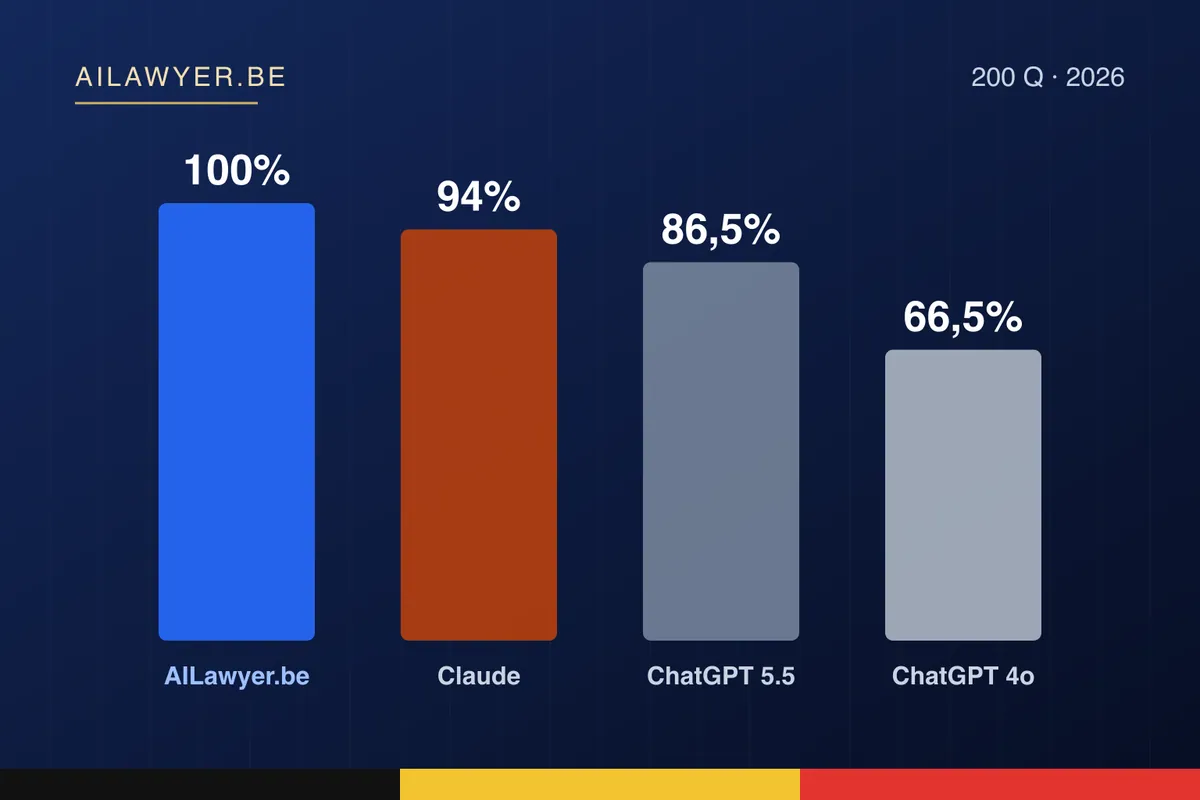
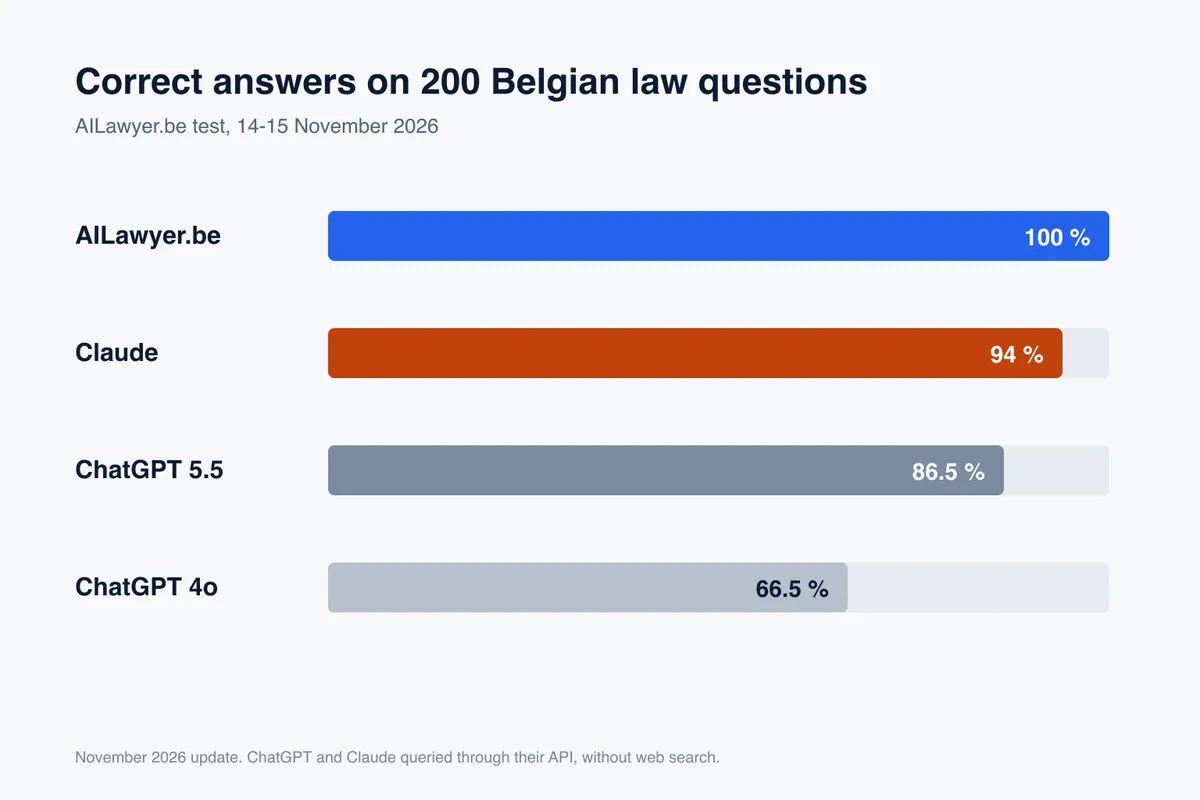
In its November 2026 update, AILawyer.be answers all 200 questions correctly. Claude comes second with 188 correct answers (94%). ChatGPT 5.5 follows with 173 (86.5%). ChatGPT 4o comes last with 133 (66.5%): one answer in three is wrong or incomplete.
That 100% deserves a clarification, and we are glad to give it. It was reached after several rounds of corrections: whenever AILawyer.be got something wrong, we checked the rule in the official texts and added it to its knowledge base. On its very first pass over 100 questions it had never seen, it scored 93%, against 95% for Claude. In other words, AILawyer.be's strength is not a magic AI model, but ongoing verification work in which every correction benefits every later user.
The picture varies a lot by field. In employment law, ChatGPT 4o finds the right answer only half the time. On contracts and limitation periods, ChatGPT gets it wrong three times out of four in both versions.
The real trap: the Belgium nobody mentions
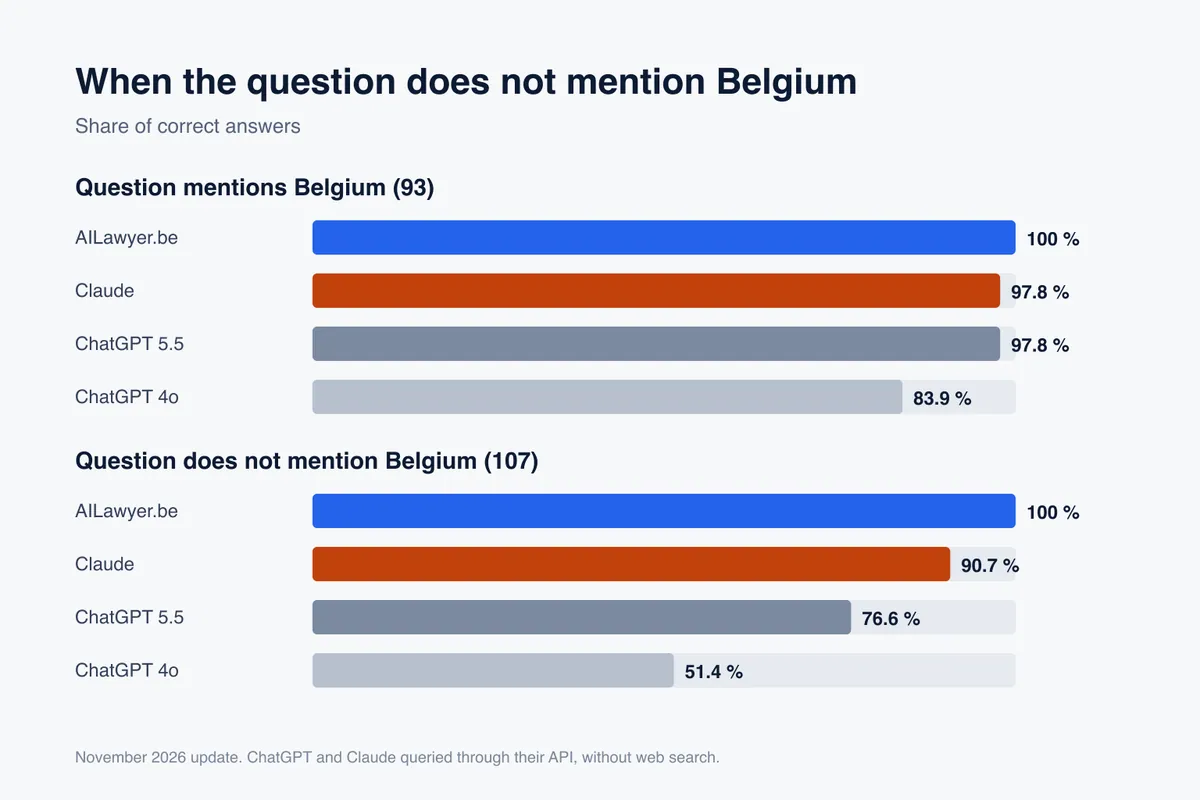
The most revealing figure in this test is not the overall ranking. It is the gap between two kinds of question. When the question says "in Belgium" or names a Region, ChatGPT 5.5 and Claude are almost perfect: 97.8% correct. When it does not, like most real questions, ChatGPT 5.5 drops to 76.6% and ChatGPT 4o to 51.4%.
The reason is simple. A general assistant does not know where the person writing to it lives. In French, it often assumes France. A reader asks whether he can pay cash for a €9,000 used car at a garage: all three rival assistants answer that the limit is €1,000, the French rule. In Belgium it is €3,000.
The same happens with resignation. To an employee on a permanent contract since March 2023, ChatGPT 5.5 replies that "there is no general statutory notice period for resignation", and Claude that the French Labour Code sets no length: the collective agreement would decide. That is true in France. In Belgium the law sets the notice: six weeks for that length of service.
These are not blunders: nothing in the question said Belgium. But for a Belgian reader, an answer that is right for France is still a wrong answer. AILawyer.be always starts from Belgian law, and asks for the Region when the rule depends on it.
Even when Belgium is named, the numbers give them away
Even when the country is clear, general assistants stumble over what changes with time. Asked for Belgium's legal interest rate in 2026, ChatGPT 5.5 says 4.25%. The correct rate is 4.5%. Claude honestly admits it has no reliable information and points to the Belgian Official Gazette. ChatGPT 4o declines to answer.
The same problem comes back with the part of a salary no creditor may seize (€1,419 net a month in 2026), the deadline to appeal to the Court of Cassation (three months) or the notice owed to an employee dismissed after ten years (33 weeks). These questions are among the nine on which ChatGPT 5.5 and Claude both go wrong.
What they share: a precise amount, rate or deadline, specific to Belgian law and sometimes revised every year. Exactly the kind of information a general AI model remembers poorly, and that a citizen cannot afford to get wrong.
What AILawyer.be does differently
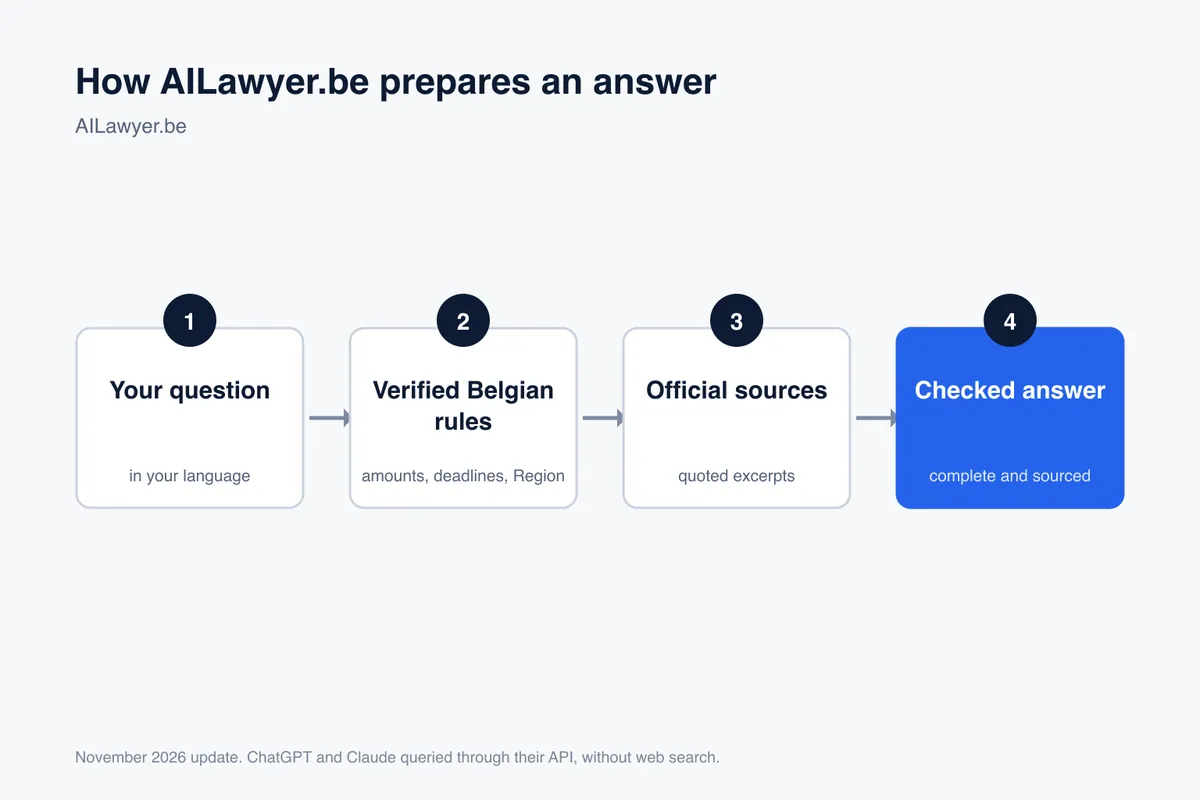
AILawyer.be does not ask the AI model to remember Belgian law. Before each answer, the server recognises the subject of the question and puts the matching verified Belgian rules in front of the model: the notice table, the cash payment limit, the year's legal interest rate, the guarantee period, each with its official source. Automated tests check these rules against the site's calculators.
Where it is useful, the assistant also consults official legal sources and quotes the excerpts it used. It tells Brussels, Wallonia and Flanders apart when the rule differs, as with rental deposits or inheritance tax. And when a decisive fact is missing, a date or a Region, it asks instead of guessing.
Finally, every answer is checked before it is displayed. An answer that is cut off, or that starts in the middle of a sentence, is requested again instead of being shown to the visitor.
The limits of this test
This test was designed and run by the publisher of AILawyer.be, Mashaah LLC. It is therefore not an independent evaluation, and we have every interest in AILawyer.be looking good. That is why we publish the method, the first-pass scores and the limits below.
ChatGPT and Claude were queried through their official programming interface, without web search. With browsing switched on, they would probably fix some of their mistakes on recent figures. AILawyer.be consults official sources when that helps.
The sample is still limited: 200 questions, a single pass for the competitors. AI models do not always answer the same way, and fields or languages with only a few questions cannot support a ranking. Finally, the grid checks that the essential facts are present, not the quality of the explanation or the tone.
So which assistant for a question on Belgian law?
For writing an email, summarising a document or thinking out loud, ChatGPT and Claude remain excellent tools. Claude in particular proved solid and careful throughout the test.
For a question on Belgian law, however, the results speak for themselves. On our test bench, AILawyer.be answers every question correctly in its November 2026 update, and it never mistakes Belgium for France. It is very probably the AI assistant best suited to Belgian law among those we tested.
It does not replace a lawyer. It helps you understand your situation, know the right deadlines and amounts, and see when it is time to get advice. Try it yourself: ask your question in the AILawyer.be chat, without even saying that you are in Belgium.
FAQ
Which AI assistants were compared?
ChatGPT in versions 4o and 5.5, Claude (Opus 5.5) and AILawyer.be, on 14 and 15 November 2026, with the same 200 questions on Belgian law.
Why does ChatGPT get Belgian law wrong?
Mainly because it does not know where the user lives: in French it often answers under French law. It also uses outdated amounts or rates.
Does AILawyer.be's 100% score mean it is never wrong?
No. The score applies to our own test bench, after corrections. On new questions it scored 93% on the first pass. AILawyer.be provides legal information, not a lawyer's advice.
Who ran this test?
Mashaah LLC, the publisher of AILawyer.be. The method, first-pass scores and limits are set out in the article.
Sources and references
General information. Application to a matter depends on its facts and the rules in force.

